Showing posts with label Safari. Show all posts

Tuesday, May 29, 2018

What is Web SQL?

Web SQL is simply SQL database that you can run in the web. It is only supported in the latest version of Safari, Chrome and Opera. Web SQL database API  are used to work with client based databases. It is well suited for web applications.

The core methods are:

openDatabase
transaction
executeSql


openDatabase create a database aobject allows you to open an existing database or allows you to create a new one.

transaction allows you control transaction helping you to commit or rollback.

executeSql allows you to execute a Sql queries.

Firefox and Microsoft Edge does not support Web SQL since it is not going to be a W3C standard. However, Web SQL are wrappers for SQLite.

Saturday, December 19, 2015

Which of Firefox and Microsoft Edge support MathML better?

This is just the view point looking at just one example and must not be construed to apply to whole of MathML. You may review some basic MathML information here.

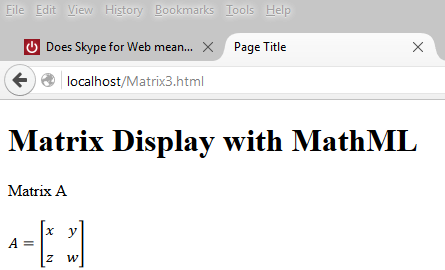
Here is an example of displaying a matrix using the presentation elements of MathML. Browsers do not support MathML the same way, some do better than others. Generally speaking browsers that support HTML5 should support MathML to some extent. This post considers only the latest versions of Firefox and Microsoft Edge at present.

This page can be hosted on a web server(in this case on the local ISS, IIS Version 10.0.10586) on Windows 10 Pro)

Matrix Display with MathML


Matrix A
 
     
  A
  =


         x
         y


         z
         w


This is a very simple page but there are differences how the browsers display them. The MathML is highlighted in yellow in the HTML page.

Firefox 42
Firefox displays as shown here without any modification. This is the correct way of displaying a matrix.


Microsoft Edge 25

The HTML code used as is (with the

Friday, December 18, 2015

Is there a test for WebRTC support in browsers?

Yes. There is a test devised by WEBRTC.ORG. You can test the browsers with this simple test. As WebRTC depend on the use of built-in devices of your computer like Camera, Audio etc, you will have to give explicit permission to their use by the test.

Mozilla Firefox passes all the tests devised by WebRTC.org as shown in the following. All you need to do is launch your browser and type in the address, test.webrtc.org. You will be asked whether you are ready to share the devices like camera, audio etc. After getting an affirmative answer you will be presented with this test screen.
Webrtc_MOZ_test.png
You start the test by hitting the Start button. The various tests are run and if you wait a little while you will get this display,

Webrtc_Moz.png

As you can see most of the tests were successful except for one. This may be due to the configuration as you see this detail:

 Reflexive connectivity
[ INFO ] Gathered candidate of Type: srflx Protocol: UDP Address: 24.25.241.5
[ WARN ] Could not connect using reflexive candidates, likely due to the network environment/configuration.


With Microsoft Edge most of the tests fail and the results are as shown in the following images:

 WebRTC-MSFT01
 WebRTC-MSFT02
WebRTC-MSFT03

I did wait for a while to see if it runs the remaining tests and it did not.

The good news however is that ORTC through its APIs, support WebRTC in Edge so that Edge can communicate with Firefox a la WEBRTC. We shall look at it in another post.

Monday, December 14, 2015

What is MathML?

ML stands for Markup Language and MathML is the markup you can use in web pages (html for example) to display mathematical equations, expressions etc.

MathML is the XML standard for encoding mathematics. It is not just for incorporating mathematics into web pages but also for communicating and exchanging mathematics in mathematical and scientific applications. While most browsers would implement MathML from a standards view point Chrome wanted to have its own way of implementing MathML. However check with the latest version of Chrome for its MathML support.

 The earliest MathML specification is at least some 8 years old. MathML is quite widely used in print books, eBooks, etc. It is also used as an exchange format to support mathematical symbols and content in Microsoft Word, Open Office etc. With all kinds of sensors entering the web by way of Internet of Things, I am positive MathML will be used more widely than at present.

Read more here:
http://www.w3.org/TR/MathML2/overview.html
http://www.dessci.com/en/reference/webmath/tech/mathml.htm